





Rolf Hilmes, Ralf Janke and Christian Schmidt

On May 7, 1971, the first series vehicles of the Marder armored personnel carrier were handed over to the troops at the same time in Kassel (Rheinstahl AG - special production) and Kiel (Krupp MaK).
When it was designed, it was assumed that the Marder infantry fighting vehicle, in conjunction with the Leopard 1 main battle tank, would make a decisive contribution to national defense in the army until around the year 2000. But the real course of the story should be different. Today, a Leopard 1 main battle tank has not been in use for 18 years and the Marder armored personnel carrier had to prove itself in firefights with the Quick Reaction Force in the areas of Kunduz and Mazar-e-Sharif. And a specific end to the vehicle's useful life is currently not foreseeable.
With this article we give all interested readers a technically oriented overview of 50 years of use, including the previous 11-year development period for this successful weapon system.
During the development phase of the Bundeswehr, the procurement of a suitable armored personnel carrier was very difficult, as no foreign vehicle optimally enabled the style of fighting practiced by the German Panzergrenadiers, with the rapid change between mounted and dismounted combat. This also became clear during the provisional procurement of the M 39 and Bren Carrier vehicles, which were already used by the Allies in World War II. Therefore, in May 1956, the Swiss company Hispano-Suiza was commissioned to develop the HS 30 infantry fighting vehicle.
For many reasons, the HS 30 project turned into a lasting disaster and the troops had little joy in this vehicle. As early as the start of delivery of the vehicles in the fall of 1959, it was clear to the army command staff that the HS 30 could only temporarily cover the immediate needs of the Panzergrenadiers, particularly for training purposes. However, it did not represent an adequate solution for an infantry fighting vehicle capable of accompanying the 30 t standard tank under development (the later Leopard 1 main battle tank) in combat.
Therefore, in the fall of 1959, the Army command staff issued the corresponding military requirements for a vehicle family under the term “new infantry fighting vehicle”, within which the infantry fighting vehicle was initially supposed to be the pilot vehicle.
The requirements for the new armored personnel carrier included:
Wie so oft bei einer Panzerentwicklung wurden am Ende zwar viele, aber nicht alle der ursprünglichen militärischen Forderungen erfüllt.



 Simply sign up for a monthly subscription to immediately benefit from all ESUT Digital advantages.For a monthly subscription
Digital half-yearly subscription
für 33,50 € / 6 Monate
Digital annual subscription
für 65 € / 12 Monate

Enjoy the premium content and other benefits ofESUT Digital:
 Spectus driver vision systems for Marder armored personnel carriers
 New thermal imaging aiming devices for the Marder armored personnel carrier
 Service life extension of the Marder 1 A5 armored personnel carrier
 Ring exchange continues: Greeks receive Marder armored personnel carrier
 Thermal imaging aiming devices for Marder 1A5 armored personnel carrier under contract
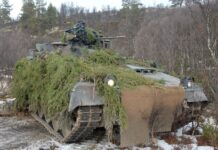 Modernization of the Marder infantry fighting vehicle on track
Germany supplies Marder and Patriot batteries to Ukraine - Bradleys come from the USA
Modernization of the Marder infantry fighting vehicle on track
Germany supplies Marder and Patriot batteries to Ukraine - Bradleys come from the USA
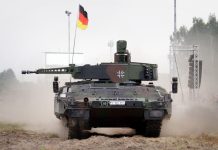 Financing secured for up to 210 additional Puma infantry fighting vehicles
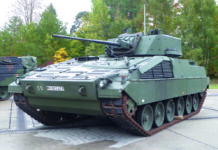 Marder armored personnel carrier – 50 years of use in the Bundeswehr