






The Franco-German development project for a joint main battle tank of the future is entering a new phase. At least that's how Defense Minister Boris Pistorius and his French counterpart Sébastien Lecornu see it. At a joint press conference this morning, the two ministers presented the current status of the joint battle tank project called "Main Ground Combat System" (MGCS).
"We were now in a diplomatic phase of the program, but today we are entering an operational phase of the program," said Lecornu, who, like Pistorius, was very satisfied with the results of the talks regarding MGCS.
Both ministers explained that the project planning now provides for regular meetings at ministerial level to ensure political control. The same applies to the Franco-German Future Combat Air System (FCAS) project, in which both countries want to develop a joint air combat system.
Während Frankreich bei FCAS die Führung inne hat, übernimmt Deutschland dies beim MGCS-Projekt.

In a next step, a meeting will probably take place on September 22 at the French air force base in Evreux to discuss a basic paper there, on the basis of which further decisions should be made.
Das in Auftrag gegebene Papier soll von den Inspekteuren des deutschen und des französischen Heeres vorgelegt werden. Dadurch solle möglichst früh die militärische Anforderung an einen Kampfpanzer der Zukunft sowie die militärische Expertise in das Projekt MGCS einfließen, so Lecornu.
The Frenchman pointed out that the project structure of MGCS differs from that used at FCAS in this respect. At FCAS, military expertise was only consulted later. Apparently this is going to be handled differently. Apart from this factor, one wants to mirror the project structure of FCAS on MGCS, as the ministers announced.
By the end of this year, Germany and France want to agree on a political paper on the common requirements for the future ground combat system. According to the French minister, the early coordination of requirements is another lesson learned from the FCAS project.
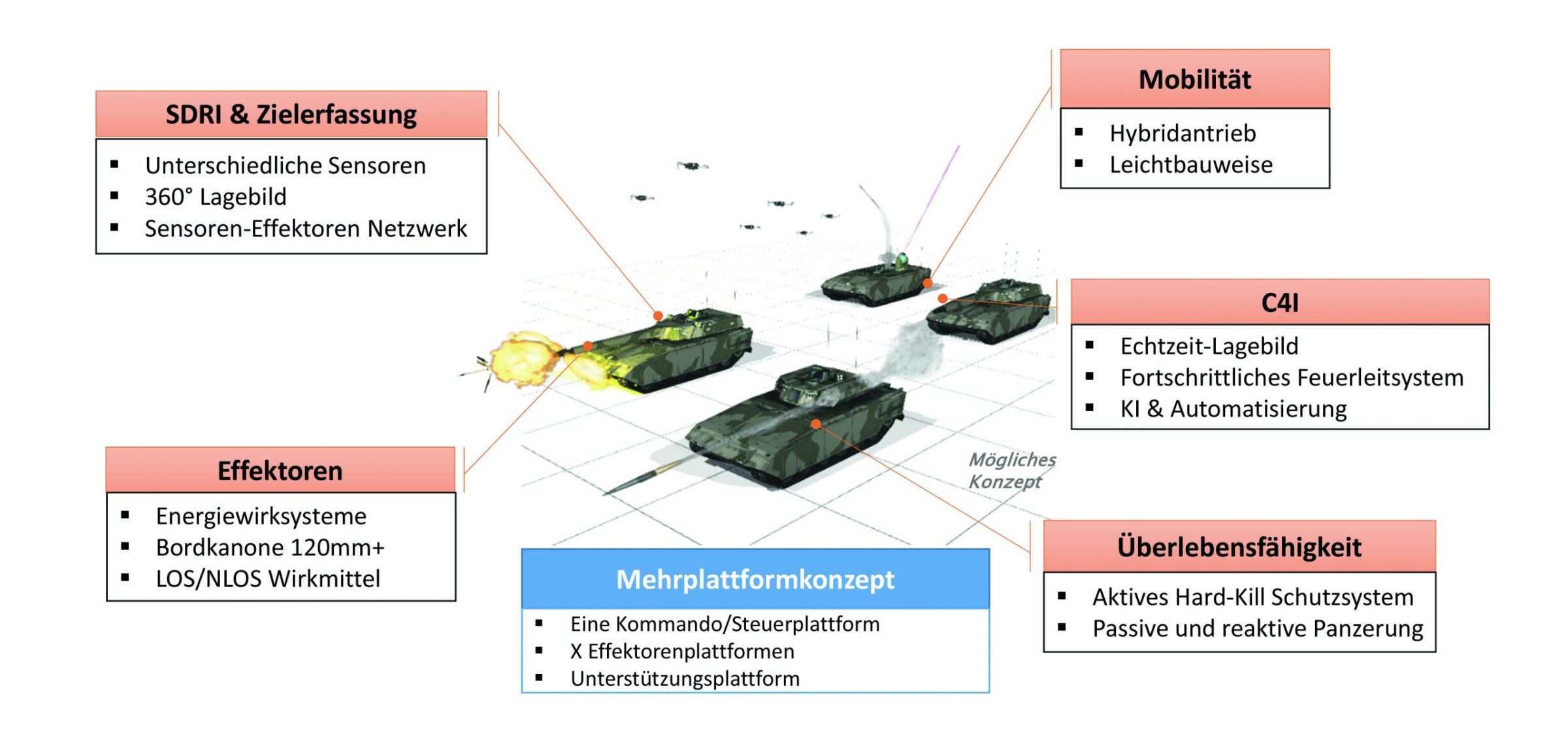
Both ministers expect a massive leap in technology from the project, which is to be implemented between 2035 and 2040. This affects all facets of the system. Lecornu said: "The tank that will leave the factory will not resemble today's tanks in anything." Pistorius also emphasized that the MGCS is not simply an evolution of the current German and French main battle tanks, but much more go.
In addition, the German Defense Minister, alluding to the criticism that MGCS has already experienced, emphasized: "Despite all prophecies of doom and all rumours, we want this joint project".
Regarding the still unresolved question of which company will supply the cannon for MGCS, Pistorius said that there could also be a parallel development for the cannon, based on a common hull and a common turret. In the end, you can then decide which system performs better. To date, the 140mm cannon from the French manufacturer Nexter, which has been in a joint holding company with the German defense company Kraus Maffei Wegmann under the name KNDS since 2015, and the 130mm cannon from the German manufacturer Rheinmetall for the main armament of MGCS are under discussion. The path outlined by Pistorius makes it clear that the question of which company will be awarded the contract is still open.
Editorial staff / oh
 Armament cooperation topic during the visit of France's defense minister to Berlin
 FCAS and MGCS: German-French lighthouse projects should be promoted
 Budget Committee releases around twelve billion euros for Ukraine
 German-French agreement on the new MGCS main battle tank signed
 Pistorius: First leopards in three months in Ukraine
 Future Combat Air System – FCMS consortium receives order for sensor network
 18 European countries are procuring ammunition for Ukraine
 French main weapon for future land combat system
 Pistorius: "I want to make the Bundeswehr strong"