









Ole Henckel

“Germany is ready to permanently station a robust brigade in Lithuania.” Defense Minister Boris Pistorius said this at a press conference in Vilnius today. The minister also formulated two requirements for such a deployment.
Firstly, the necessary infrastructure must be in place. “We are talking about around 4,000 soldiers in the brigade, plus material and, if stationed permanently, also families,” said the minister. It would need barracks, training facilities and depots for storing equipment and ammunition.
Pistorius cited compatibility with NATO's plans as a second requirement. The principle of military flexibility must be preserved, said Pistorius. With the principle of military flexibility, the minister could refer to NATO's limited resources, which, given the length of the eastern flank, cannot be stationed rigidly and over a large area, but must be used flexibly, namely where a possible threat arises.
Mit der klaren Aussage des Verteidigungsministers, dass Deutschland grundsätzlich bereit sei, eine robuste Brigade in Litauen zu stationieren, hat die Debatte um dieses Thema eine überraschende Wendung bekommen. Bislang drehte sich die Diskussion darum, wie das gemeinsame Kommuniqué, das Bundeskanzler Olaf Scholz und der litauische Staatspräsident Gitanas Nauseda im Juni des vergangenen Jahres verabschiedet hatten, ausgelegt werden soll. Während Litauen aus diesem die Zusage herauslas, das Deutschland eine Kampfbrigade dauerhaft in dem baltischen Land stationieren würde, sah man in Berlin die Sachlage etwas anders. Die deutsche Interpretation sah dabei die permanente Stationierung eines Brigadegefechtsstandes vor und die Möglichkeit, die dazugehörigen Truppen innerhalb kurzer Zeit aus ihren Heimatstandorten nach Litauen zu verlegen. Die litauische Seite hat sich mit dieser deutschen Sichtweise auf Sachlage nicht zufriedengegeben und nun offenbar die Bundesregierung dazu bewegen können, sich für eine dauerhafte Stationierung der vollständigen Brigade auszusprechen.




Regarding the timing of such a permanent deployment, Pistorius said that the expansion of German troops would be planned step by step with the expansion of the existing infrastructure. According to Lithuanian Foreign Minister Gabrielius Landsbergis, accommodation and depots for the Germans should be completed in 2026.
Die Folgen einer solchen dauerhaften Stationierung von Kampftruppen an der Ost-Flanke der NATO für die NATO-Russland-Grundakte von 1997 ist noch unklar. In dieser heißt es: „Die NATO wiederholt, daß das Bündnis in dem gegenwärtigen und vorhersehbaren Sicherheitsumfeld seine kollektive Verteidigung und andere Aufgaben eher dadurch wahrnimmt, daß es die erforderliche Interoperabilität, Integration und Fähigkeit zur Verstärkung gewährleistet, als daß es zusätzlich substantielle Kampftruppen dauerhaft stationiert.“
While Russia has repeatedly violated the agreements in the Founding Act with its attack on Ukraine, Germany and NATO are currently still sticking to the agreement. A spokesman for the Ministry of Defense confirmed this to ES&T. Regarding a possible permanent stationing of a German combat brigade in Lithuania, the spokesman said: “The NATO-Russia Founding Act repeats, among other things, a political commitment by NATO not to permanently station substantial combat troops in the territory of the new members, depending on the security environment that existed at the time.
“The current strengthening of NATO’s deterrence and defense posture, including troop deployments to NATO’s Eastern Allies, are appropriate, proportionate and in response to the significant deterioration in the security environment caused by Russia, particularly compared to 1997.”
The Defense Ministry therefore assumes that the permanent stationing of a German brigade in Lithuania is in accordance with the NATO-Russia Founding Act.
The deployment itself would be a strong foreign and security policy signal from the Federal Republic and would meet the wishes of its international partners, who are demanding that Germany, as the economically strongest country in Europe, also play a correspondingly strong role in the area of defense. In addition, by sending a brigade to Lithuania, the Federal Government would also be fulfilling a strategic goal from its National Security Strategy, which was formulated as follows: “The Federal Government will further expand and consolidate its military presence in the alliance area to protect our alliance partners, also as a military partner to be able to serve our allies.”
Ole Henckel
 Maintenance of NATO vehicles in the Baltics – Krauss-Maffei Wegmann and Rheinmetall establish a joint venture
 Lithuanian Defense Minister calls for permanent presence of German combat brigade
 Tank barriers to secure the Polish eastern border
 Three summits - the same message: further support for Ukraine, condemnation of Russia - no escalation
 First training mission of the German brigade in Lithuania
 German Panzergrenadiers relocate permanently to Lithuania
 Türkiye leads NATO spearhead in 2021
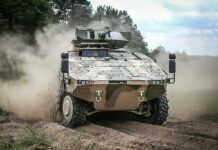 More than 100 more boxers for Lithuania
 Ukraine crisis: Ministry of Defense is considering further measures